Wednesday, February 5, 2014

Cider #1 Review

I have recently been branching out from beer into other fermented beverages besides beer. In October 2013 I started a cider, and lasted weekend I started a mead. The cider was actually ready and drinkable in mid-December 2013. After only a week in the bottle it had a bit of a nasty sulfur note, but by January that seems to have mostly disappeared. I've heard that cider tends to age pretty well, so perhaps this tasting will be a further improvement.

Appearance: Pale yellow and translucent. (Even though it doesn't come across in the photo.) Almost zero foam on the surface. Lots of small carbonation bubbles cling to the side of the glass. It could be mistaken for nearly flat Champagne or a glass of white wine.
The color is much light than that of the opaque, coppery-brown pre-fermentation cider. How does fermentation change the color and transparency of the cider?

Aroma: I still get a sulfury not from the yeast, and not a whole lot of apple-like smell. The Champagne yeast does seem to have imparted a kind of white-wine like smell that may obscure the apply quality. Still my wife said that it did have a sourish apple smell. She and I do seem to have differently calibrated noses.

Taste: It doesn't have a strong taste, but I would say this it does have a nice apple taste, and like the nose, some white-winey notes. It does not have a sour bite at all - the campden had its intended effect. I get almost no sweetness. It's very dry, as I was told to expect with Champagne yeast. Also the flavor seems to improve a little bit as it warms. It doesn't have any boozy note in the taste as it is likely around 4%-5% ABV.

Mouthfeel: Low carbonation. It's doesn't have a big body but fortunately doesn't seem thin and effervescent, like highly-carbed Champagne can. The aftertaste does seem to have an apple quality.

Overall:  A pretty dry, low carbonation cider, with some apple flavor and quite some similarity to white wine. Some sulfur in the nose.

As yet, this cider is young. I will need to keep a few bottles around to see how it taste after a year of aging. I will probably make some cider again, though perhaps use a less attenuative yeast, and some sour apples. The sourness can accentuate the apple flavors.


Sunday, February 2, 2014

3 Gallons of Mead

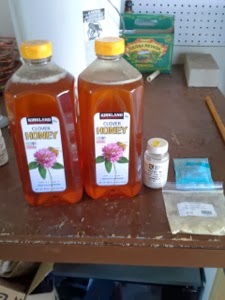
So, I brewed some mead today. No special reason, except that off-brand "Kirkland" honey at Costco was $13 per 5-gallons. I'm cheap, and I'm not expecting to make an award winning mead with stuff, especially as it's my first venture with mead.

 Mead:
10# Kirkland Clover Honey
2.25 gallons water
1 tsp. Yeast Energize
1.5 tsp. LD Carlson Yeast Nutrient

Red Star Premier Gran CuvĂ©e Wine Yeast 

Expected OG / FG: ??

Brewed 2/2/14.
 

Put a little bit of Campden in 2.25 gallons cold water to de-chlorinate it. Began heating up the water.


Poured the honey directly into the brewpot as the water was being heated. Stirred to mix in the honey, so that it didn't sink to the bottom and get scorched. Each 5# bottle of honey was about a 1/2 gallon, so I probably got around 3.25-2.5 gallons of "wort".

Immediately after pitching, w/ Star-San foam.
Heated to 180F. The "wort" smelled good - like honey. It developed some bubbles and a little bit of dark stuff on the top. I didn't skim anything off of it. Just stirred a bit.

Turned off the heat at 190F, then let air-cool, although eventually I did put the kettle in a tub of cool water.

Fermentation has started, but no Krausen.
Rehydrated yeast as per instructions, and pitched after aerating 70F "wort".

Measured the OG at 27 Brix, or 1.115 Gravity. So I'm looking at a brew of approximately 16% - 17% ABV.

2/5/14 - Airlock activity at about one bubble every 2 seconds, but unlike beer, no krausen or foaming on the surface. I can see some activity in the liquid however. The appearance of the mead has not changed substantially. It still looks like a murky, yellowish liquid.

Late march - added 3 lbs of mixed berries - strawberries, raspberries, blueberries, and blackberries to ~2 gallons, and racked the un-fruited portion to a 1-gallon jug.

6/7/14 or thereabouts - Bottled the un-fruited portion in screw-cap wine bottles, and racked the fruited portion to a tertiary fermenter.


West Coast IPA Review

Still working on my hoppy beers. This one is good, but again not exactly what I was hoping for. At some point, I will need to do a DIPA in order to basically see how much hop aroma I can get into my beer.

Appearance: Orange-copper in color, with a fluffy, slightly off-white head that sticks around pretty well. Nearly transparent, especially if I am very careful not to pour in any yeast.

Aroma: Fruity American hops- perhaps a bit a Cascade coming through. Aroma was good, but generally not as strong as I would hope for.

Taste: There's a reasonable amount of hoppy flavor - kind of fruity, a bit piney. I also get a little bit of malty sweetness in the aftertaste. Bitter, but smooth. The first-wort hopping seems to smooth out the bitter finish, especially in contrast to the Rye-IPA I made a while ago, in which the high bitterness and the spicyness of the rye combined to make a bit of a harsh taste.

Moutfeel: Medium carbonation. A bit thin in the mouthfeel, in my view. Aftertaste is a smooth bitterness.
 
Overall:  A smoothly bitter, somewhat fruity American IPA with a thin body. In my view, not bursting with hop aroma enough and a little too thin in body. Perhaps more like a Pale Ale. Still, it's good, and I do enjoy is, as do my wife and brother.

For next time: Try to find a way to get the huge hop aroma some beers have. Is it a recipe issue - i.e. volume of hops - or a technique issue - i.e. cooling time? Experimentation is in order. I will set up my March pump for the next brew, and do a whirlpool hopping system. I'd also like to get a resiny, coating mouthfeel that some IPAs have, in contrast to the kind of thin body here.


Tuesday, January 21, 2014

Smoked Porter #4

The Boston Homebrew Competition is coming up. This year, I have decided to enter a smoked porter, not just before it is a favorite style of mine, but also because my wife really likes it and because I think I can brew it relatively well.

For this brew, I'll be changing the recipe slightly in order to make it a little less sweet than my previous brew of this style. Last month I had a sample of Alaskan Smoked Porter, which was delicious, but less sweet than my own brew - not more acrid exactly, but a little roastier and dryer than my own. Basically, I knocked down the amount of Crystal malt a little, and added more chocolate and black-patent malt to achieve the desired dry-roasty quality, while keeping the base malt and the percentage of Cherry-smoked malt the same.

Smoked Porter #4
3 Gallons

5.125# US 2-Row
2.5# Cherry Smoked Malt
10oz Munich I
8oz Crystal 40
8oz Chocolate
6oz Crystal 90
5oz Black Patent Malt

1oz Goldings, 60min, pellet, 5% AA
.5 oz Willamette, 45min, 4.9% AA
.5oz Willamette, 10min, 4.9% AA
.5oz Goldings, 5min, 5% AA
.5oz Willamette, 5min, 4.9% AA

Expected OG / FG/ IBU/ ABV: 1.068, 1.017, 42, 6.6%

 Mash at 152F, 60 minute boil

Made a starter with washed US-05 on 1/19/14

Brewed 1/20/14

Mash temp was good, in the 152F -150F range depending on where in the mash I placed my thermometer. Used my 5-gallon round cooler with the CPVC manifold this time. No stuck sparges, though a pretty small leak in the manifold of the MLT.

Got about 4.25 gallons of pre-boil wort, at an OG of around 1.055.

Used a calibration stick to measure the volume of wort, and then adjusted the boil to try to hit my target volume. At the end of the boil, there was around 3.25 gallons of wort, so I seem to have measured things right.

Cooled, using the rig pictured, to around 90F, then racked to a PET carboy. Let stand in 35F - 40F ambient air for a few hours to cool. Pitched at around 65F, and let the  bottle sit in 62F ambient air. Fortunately this time the sump-pump was working properly.

Because I racked when the wort was still relatively hot, it was not as clear as I was hoping. I did leave about a quart of trub in the bucket, which I then poured into a pitcher. After a while some clear wort was on top - enough for a hydrometer sample reading 1.070. Yay, hit my target OG pretty spot-on.

2/2/14- Bottled today with 2 oz of sugar. Fermentation seemed to have been quick but did not generate a very large krausen, likely because of the restrained temperatures, in the 60F - 64F range. Measure FG at 1.018.


Saturday, January 18, 2014

Consecration Clone Recipe

So time for another long-term sour project. For this one, I took my clue from a clone kit available from MoreBeer.com, but made some variations to the recipe, and for reasons that will become apparent below, it's not likely to be an accurate clone of the target beer - Consecration, from Russian River Brewing.

This one may take about a year to eighteen months to be ready. The brewery's webpage says it is aged for 6-8 months, but I have heard that Roselare can take even longer to develop its full flavor.

Since this one takes so that long to be ready, it makes sense to brew a full batch. Most of the "work" associated with this one is storage, and since the beer will most likely improve with age, I don't have to worry about drinking it while fresh. So, this is my first 5 gallon batch.

Consecration Clone - 5 Gallon

11# Belgian Pilsner
1# Light malt extract
1# Brown Sugar
1# D-45 Candi syrup
8oz Acid Malt
4oz Carafa I
4oz Special B

.5 oz Styrian Goldings, 90min
1 oz Styrian Goldings, 30min
.5 oz Styrian Goldings, 1 min

Wyeast 1214 - Abbey Ale
Wyeast Roselare mix

2# black currants, secondary
2.5 oz Cabernet Sauvignon soaked oak cubs, secondary

Age ~ 1 year.

Mash at 158F, mash out, infuse with ~175F water for mashout temp of about 165F.

Expected OG / FG / IBUs: 1.071 / 1.018 / 16 / 6.9%

Brewed - 1/12/14

Hit my mash temps pretty well, both for the mash and the mash-out, but using my large square MLT, I realized that it has quite some dead space, so I was under-volume for the boil. As a result, I added about .75 gal to the boil in order to allow for boil-off over the course of 90 minutes.

The boil went fine, but at the end, the submersible sump-pump I've been using to push cool water through my chiller would not turn on. There seemed to be some type of electrical fault, as the power brick has a TEST / RESET button that wouldn't go to normal operation. Electricity and water should not be mixed. So instead, I filled a big grey bin full of cold water and put the brewpot in there. This was the same method I used before I got my chiller.

In any case, I left the beer like that at around 4pm, in the 40F weather. By around 10pm the beer was at 60F, so I transferred to the fermenter and pitched the WY1214. I got about 5.25 gallons. Unfortunately, I had not made a starter, although I had taken the yeast out of the fridge and popped the smack-pack earlier that day.

I took the fermenting bucket down to the basement where it was around 59F - 60F. That was probably too low. No bubbles on Monday afternoon, so I moved it to a warmer area where it was 62F. I didn't want it to get above 65F for the initial fermentation, in order to avoid hot alcohols, etc. from an overly vigorous fermentation in a higher-gravity wort.

1/114/14 - No signs of fermentation at all; even when I opened the bucket, I could not see any bubbles or krausen. So, thinking that the yeast had either fallen asleep or died or something, I just pitched the Roselare right in, even though that was not specified in the recipe. Oh well. I really didn't want the beer to get infected from a poor fermentation.

1/15/14 - Bubbling in the airlock, krausen forming. Yay!

2/5/14 - Transferred to a Better Bottle for secondary, but did not add currants or oak. There was the beginning of a pellicle starting to form when I opened the top of the bucket. The beer smelled good, and had a brownish appearance.  Did not take gravity reading. Placed in 68F-70F ambient air.

3/1/14 - Added the recycled yeast and a couple of oak cubes from my Flanders Red into the secondary. A few days later a brownish krausen seemed to appear on the surface of the beer. It has stayed there since.

3/31/14 - Added 2 pounds of organic raisins from Whole Foods. They had Zante currants, but on inspecting the ingredients I found that there was also peanut oil, vegetable oil, etc. in the container. I don't know why those were in there and I don't want oils in my beer. So I just used some raisins instead, which probably will have a fairly similar effect on the beer.

7/4/14 - Racked off the raisins into a tertiary container. Frustratingly, it was impossible to separate the raisins from the beer, resulting in about 1 gallon getting stuck and wasted. I am considering brewing a 1-gallon batch and starting a solera type thing.

6/11/15 - At some point a long time ago I did add some top-up beer. Bottled in mid May 15 with some wine yeast. A sample bottle tasted quite nice but was undercarbed. I hope I don't get bottle bombs. Now the bottles have pellicles, despite that there is (hopefully) very little sugar left for the microbes to ferment. Will open another bottle soon.


Thursday, January 9, 2014

Black Forest Stout Review

So...... Long time no post? Yes, yes indeed. The holidays have made me busy, and reduced my brewing activity, though not my drinking (and eating) activity, so much so that I went on a beer diet for a week.

Anyway, after a bit of a hiatus from posting here, I'm back with this review of my Black Forest Stout. 
Aroma: Hard to describe. To me it doesn't scream chocolate or cherry; you kind of have to pay close attention to find them in there. But I do get some dark chocolate notes and fruity cherry notes. I think the chocolate is more noticeable in the aroma.

Taste: I would say the acid / sourness and fruityness of the cherries dominate here. The acidity especially, as there seems to be little sweetness, or perhaps what sweetness there is has been dominated by the cherry / sour flavors. There's some bitter, unsweetened chocolate in there too, which is detectable but again you kind of have to search for it. The roasty or acrid character of a stout, to my pallet, does not really make an appearance.

Mouthfeel: Surprisingly, pretty thick and creamy, with low carbonation. A kind of weird, sour and chocolatey aftertaste.

Overall: It's drinkable and good, with a cherry kick, but not in balance and not chocolatey enough. My experience with fruit so far has been that it reduces the sweetness of the beer by adding a lot of unfermentable sugars and acidity, which causes the perceived sourness to increase. For this one, I would need to find some way to make it more chocolatey and better balanced with the cherry flavor. And, given the acidity of the cherries and the bitterness of unsweetened chocolate, it probably ought to be sweeter, just like a Black Forest Cake would be.

Wednesday, December 18, 2013

West Coast IPA

Of all the beers that I'd really like to get good at brewing, probably IPA is at the top of the list. No matter what the season or the circumstances, a good IPA with a wallop of hop aroma and flavor will always hit the spot. None of my IPA have been great, but they're slowly getting better. We'll see how this one goes....

This recipe came from a blog called West Coast Brewing and although I know nothing about the brewer, he and his buddies seem to like it, so why not. Plus, it doesn't call for an enormous (and expensive) volume of hops, potentially making it an efficient way to brew a good IPA. (Saving on hops, not too much beer lost to absorption by the hops.)

I did a double brew-day with two guys in the homebrewing club. The other beer was a Bitter, for which we used my larger cooler mash tun and its stainless bazooka screen. The tun performed well, although it seemed to loose more wort to tun deadspace than my round cooler.

The cooler, on the other hand, wouldn't stop leaking. So I just mashed in my kettle and used the tun to sparge. Probably this resulted in some efficiency loss, but that's OK. Anyway, it's always a work in progress. Eventually I will find the right combination of hardware pieces to fully seal the round cooler with the new 1/2" fittings and CPVC manifold.

West Coast IPA
 3-Gallons

6# US 2-Row
10oz C40
6oz C20

.5oz Centenial, 9.7%AA, first wort
.75oz Centenial, 9.7%AA, 20min
.5oz Centenial, 9.7%AA, 10min
.5oz Cascade, 6.4%AA, 0min
1.5oz Cascade, 6.4%, dry, 7 days

US-05 Yeast

2grams Gypsum
1gram CaCl

Mash @152F, 1 hour

1 hour boil

Expected OG/FG/IBU/ABV: 1.046 / 1.011 / 4.5 / 59

Brewed on 12/14/13

Initial Mash temps were good, but the kettle doesn't hold heat too well, so I had to use direct heat and stir. Sparge was OK but probably not hot enough.

Pre-Boil OG was in the 1.035 range, so I added 1lb of dry malt extract to compensate, and get rid of some of the extract I had lying around.

Boil went fine. Got a nice vigorous boil but I suspect I was over my target volume a bit.

Cooled to around 110F using my immersion chiller , and transferred to Better Bottle, being careful not to aerate.  It was about 25F and snowing outside, so I just let the Better Bottle sit outside for a while, until it felt cool to the touch. This took about 3 hours.

Pitched around 7pm, and shook the vigorously to aerate.

Let the BB sit in a tub of water, around 60F ambient. 

12/16/13, 6pm - About a quarter inch of krausen has formed.

12/17/13, 6pm - Fermentation is more active, with maybe 3/4" - 1" of krausen.

12/18/13, 6:15pm - Fermentation is even more active. Likely to be high krausen.

12/24/13 - After moving the carboy on 12/22/13 to a room temperature area to finish up, fermentation is now going very slowly and the yeast is starting to sink. I guess the low temps in the basement really keep fermentation slow.

12/26/13 - Racked to secondary and added the dry hops.

1/3/13 - Bottled, going for 2 units of carbonation. Got about 1.25 gallons - 24 * 12oz and a few 22oz bottles. The sample tasted good, with an OK aroma.